
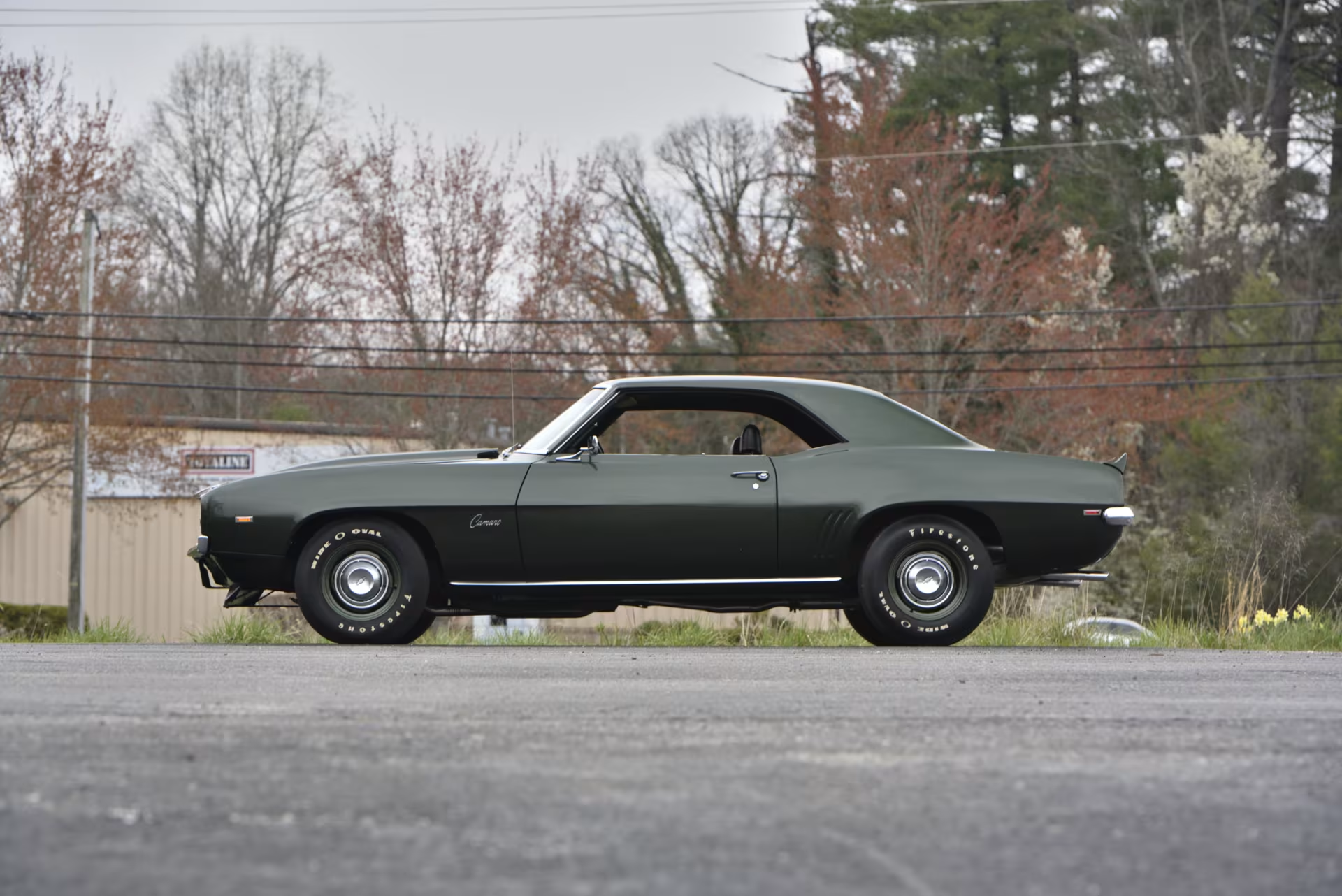
The Rebellion That Birthed a Legend
In the golden era of American muscle cars, true innovation often emerged not from corporate boardrooms but from those willing to bend the rules. The 1969 Chevrolet COPO Camaro stands as perhaps the most brilliant example of automotive rebellion ever conceived—a vehicle that wasn’t supposed to exist according to General Motors’ own regulations, yet became one of the most coveted muscle cars in history.
When General Motors established its corporate edict limiting vehicles in the Camaro’s class to engines no larger than 400 cubic inches, it seemed the muscle car wars had established a clear boundary. But passion for performance knows no limits, and where there’s determination, there’s always a loophole to be found.
The COPO System: Corporate Loophole as Automotive Revolution
The Central Office Production Order (COPO) system was originally designed for fleet vehicles and special equipment needs—police cars, taxis, and other utilitarian purposes. It was never intended as a performance vehicle program. Yet this humble administrative process would become the secret passage through GM’s corporate restrictions.
Fred Gibb, a forward-thinking Chevrolet dealer with racing in his blood, recognized the potential. Working with Chevrolet product manager Vince Piggins, they utilized the COPO system to do something extraordinary—place Chevrolet’s beastly 427 cubic-inch engines into the relatively lightweight Camaro body.
The result wasn’t just another muscle car. It was a revolution on wheels.
Two Paths to Performance Perfection
The COPO Camaro program broke the rules in two distinct ways:
-
COPO 9561 – The “mainstream” rebellion, featuring the L72 427 engine with an advertised 425 horsepower (though many believe this was deliberately underrated)
-
COPO 9560 – The ultimate expression of performance, equipped with the aluminum ZL1 427 engine, officially rated at 430 horsepower but capable of exceeding 500 horsepower with minor modifications
The performance numbers told a story that would become automotive legend:
- Quarter-mile times in the low 13-second range straight from the factory
- With minor tuning, ZL1 models could break into the 11-second range—territory that remains impressive even by today’s standards
- All this in a package that visually gave few clues to its extraordinary capabilities
Sleeper Status: The Art of Understated Power
Perhaps what makes the COPO Camaro so fascinating is its deliberate understatement. Unlike other muscle cars of the era with their bold stripes, scoops, and aggressive styling cues, the COPO Camaro maintained a relatively low profile.
It was the original “sleeper”—a car whose appearance belied its extraordinary capabilities. Available in limited colors and with minimal visual enhancements, these cars were built for those who valued performance over showmanship.
The COPO Camaro wasn’t about looking fast. It was about being fast—genuinely, frighteningly fast—in an era when that quality alone was enough to secure legendary status.
Rarity Defined: Production Numbers That Ensure Exclusivity
The COPO Camaro’s legendary status is amplified by its scarcity:
- Approximately 1,000 COPO 9561 models with the iron-block 427 engine
- A mere 69 COPO 9560 ZL1 models—making them among the rarest production Chevrolets ever created
This scarcity wasn’t accidental. The ZL1 engine alone nearly doubled the price of the car, making it an extraordinary investment even when new. Few could justify the cost, but those who did secured a piece of automotive history that would prove to be one of the wisest automotive investments of the century.
The Investment Grade Muscle Car
Today, the COPO Camaro stands as one of the most valuable American muscle cars ever produced. The market has recognized what enthusiasts have always known:
- Original COPO 9561 models regularly command six-figure prices at auction
- Authentic ZL1 models have reached beyond the $1 million mark at prestigious auctions
- Their values continue to appreciate as they represent the perfect convergence of rarity, performance, and historical significance
For collectors, the COPO represents the pinnacle of muscle car investment—assets that have consistently outperformed many traditional investment vehicles while providing the irreplaceable joy of owning a piece of automotive history.
The Legacy That Defined an Era
The significance of the COPO Camaro extends far beyond its performance figures or auction prices. It represents a moment in American automotive history when ingenuity and passion found a way to circumvent corporate limitations.
The COPO program demonstrated that:
- Rules designed to limit performance could be overcome through creativity
- The relationship between manufacturers and dealers can drive innovation
- Sometimes the most significant automotive achievements happen outside the normal production channels
This spirit of rebellion—finding ways to deliver extraordinary performance despite obstacles—defined the muscle car era and continues to inspire automotive enthusiasts today.
Preserving Automotive Royalty
For those fortunate enough to own or restore a COPO Camaro, the responsibility extends beyond mere ownership. These vehicles represent a critical chapter in automotive history—a moment when American performance reached its zenith before emissions regulations and fuel economy concerns forever changed the landscape.
Restoration of these vehicles involves:
- Exhaustive research to ensure period-correct components
- Documentation verification to confirm authentic COPO status
- Balancing preservation with drivability decisions
- Maintaining the understated appearance that made these cars special
Each preserved COPO Camaro serves as a rolling museum piece—tangible evidence of America’s performance heritage and the innovative spirit that created it.
The Emotional Connection
Beyond the technical specifications and investment potential lies the real reason these cars matter—they evoke an emotional response unlike almost any other vehicle. The COPO Camaro represents automotive passion in its purest form.
To sit behind the wheel of a COPO Camaro is to connect with a time when performance was raw and unfiltered, when the relationship between driver and machine was direct and unmediated by electronics. The mechanical symphony of its 427 cubic inches, the physical demands of managing its prodigious power, and the knowledge that you’re experiencing something truly rare—these create an automotive experience that transcends transportation.
The Question of Legacy
As we look back on the COPO Camaro’s extraordinary story, we’re left with important questions about our automotive heritage and how we preserve it for future generations. What defines automotive greatness? Is it raw performance figures? Historical significance? The stories behind the machine?
The COPO Camaro suggests it might be all of these things—a perfect storm of performance, rebellion, rarity, and historical timing that created something greater than the sum of its parts.
What piece of automotive history speaks to you on this level? Which vehicles do you believe deserve preservation not just as machines, but as cultural artifacts that tell the story of American innovation and passion? And perhaps most importantly, how do we ensure these stories and experiences remain accessible to future generations who will never know firsthand the era that produced such magnificent machines?
The 1969 COPO Camaro doesn’t just deserve a place in automotive history—it helps define what automotive history means, and why it matters to preserve these mechanical time capsules of American ingenuity and rebellion.

I am truly thankful to the owner of this web site who has shared this fantastic piece of writing at at this place.
I just like the helpful information you provide in your articles
Good post! We will be linking to this particularly great post on our site. Keep up the great writing